
Fractionated Analysis
In order to assess soil fertility appropriately and to deduce proper amelioration measures, we analyze soils in our laboratory according to the method of the “Fractionated Analysis” (certified according to ÖNORM S2122-1). Developed by the Austrian soil scientist Professor Husz, the analysis depicts the complexity of soil fertility via the determination of 120 individual parameters.
Therefore, nutrients and potential pollutants are measured in their different availabilities (= fractions): water-soluble, exchangeable and reserve fraction. This allows the identification of nutrient ratios and potentially mobilizable reserve substances. We are constantly refining the method by integrating current findings of soil research and requirements from agricultural practice.
The following chart represents the parameters and the methods of analysis.
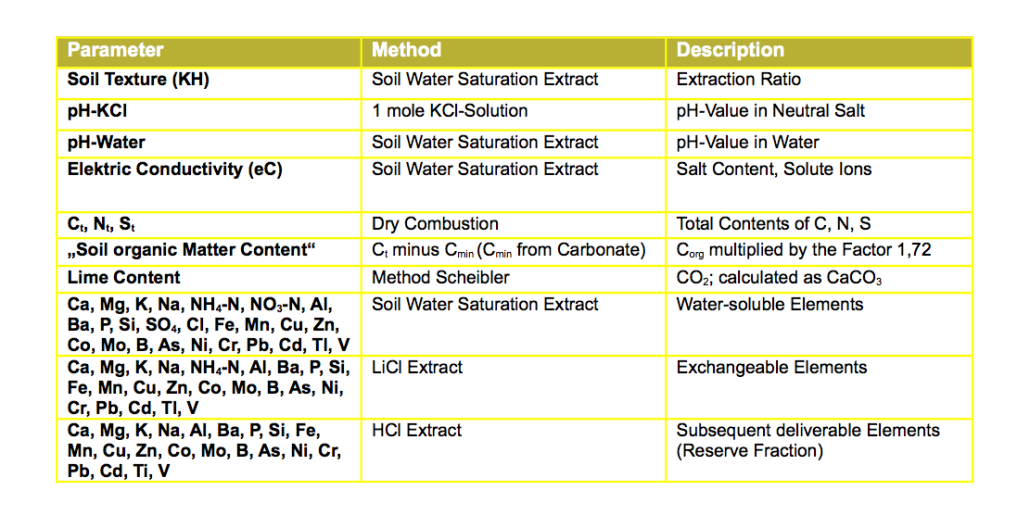
Summary of the analytics used
Water-soluble Elements / Fraction
The most mobile fraction of substances is the “water-soluble fraction”. These are substances that are dissolved in the water-filled pores after a precipitation event. They can be either absorbed directly by the plant roots or washed out with the leachate.
The water-soluble elements of a soil determine the concentration of the substances in the soil solution, which is the most important medium for plant nutrition. The soil solution should have an “ideal composition” of the individual nutrients, as the plants can only make very limited selections when taking up nutrients.
Information sheet Water-soluble Elements
Exchangeable Elements / Fraction
The “exchangeable fraction” compromises substances that adhere to negatively or positively charged surfaces of clay and humus particles due to the charge difference. These substances can be displaced from the surfaces by other charged particles and subsequently enrich the soil solution. This fraction is one of the most important pool for plant nutrition!
Information sheet Exchangeable Elements
Plant-available Elements / Fraction
Plant-available elements are those elements which are provided in an accessible form for plant nutrition during the vegetation period. They are the sum of water-soluble and exchangeable elements.
Information sheet Plant-available Elements
Subsequently deliverable Elements / Reserve Fraction
Elements in the reserve fraction / subsequently deliverable elements become accessible to plants by natural weathering processes within 10 to 15 years. For ecological and economic reasons, it may be reasonable to mobilize the existing reserve pools instead of adding fertilizers.
Information sheet Subsequently deliverable Elements
Analysis of the Phosphorus (P) Pools
Studies (e.g. Köster and Nieder 2007) as well as our own research shows that most of the agriculturally used soils contain enormous phosphorus reserves (up to 3000 kg/ha in 30 cm of depth). These reserves are only partly immediately available to plants. Knowing the different chemical bond types of phosphorus empowers to recommend specific activities to mobilize P and integrate P into the biologic cycle again. In this respect, we are analyzing and assessing the following 5 phosphorus pools:
- Water-soluble phosphorus
- Exchangeable phosphorus
- Mineral phosphorus reserve
- Organic phosphorus reserve
- Total contents of phosphorus
Information sheet Phosphorus in Soil
References
Köster W., R. Nieder (2007). Wann ist eine Grunddüngung mit Phosphor, Kalium und Magnesium wirtschaftlich vertretbar? www.beratung-mal-anders.de
ÖNORM S 2122-1 (2013). Erden aus Abfällen. Teil 1: Fraktionierte Analyse – Untersuchungsmethoden.
